Quantum computing represents one of the most significant long-term infrastructure challenges facing all digital financial systems. The good news? Stablecoins and blockchain infrastructure may be uniquely positioned to adapt.
With more than $270 billion in circulating stablecoin supply¹ now integrated into mainstream payments, proactive preparation for the quantum era is essential. A new white paper from Visa Research and Visa Crypto explains why blockchain-based payment systems have inherent advantages in migrating to quantum-resistant infrastructure. Here's what the industry and financial institutions need to know about quantum computing and how to prepare.
Understanding the quantum challenge
Modern financial systems, from traditional payment networks to blockchain protocols, rely on cryptographic algorithms like RSA, ECDSA, and Ed25519 to secure transactions. Quantum computers, once sufficiently powerful, could solve certain mathematical problems exponentially faster than traditional computers, requiring cryptographic upgrades across the entire financial sector.
The challenge isn't unique to stablecoins; it affects every institution using public-key cryptography.
How stablecoins are well-positioned to adapt
While quantum computing presents challenges for all financial infrastructure, blockchain-based systems like stablecoins have several advantages when it comes to staying ahead of what’s coming:
Programmable infrastructure: Built-in upgradeability through governance, unlike decades-old legacy systems
Transparent development: Open-source protocols enable global collaboration on quantum-resistant solutions
Flexible architecture: Modern key management (account abstraction, MPC, threshold signatures) allows smooth algorithm migration
Where we stand today
The top blockchain networks, such as Ethereum, Tron, Solana, BNB Chain, and major Layer 2s, host over 80% of global stablecoin supply. None currently use quantum-resistant cryptography, which is expected since quantum computers don't yet pose an immediate threat.
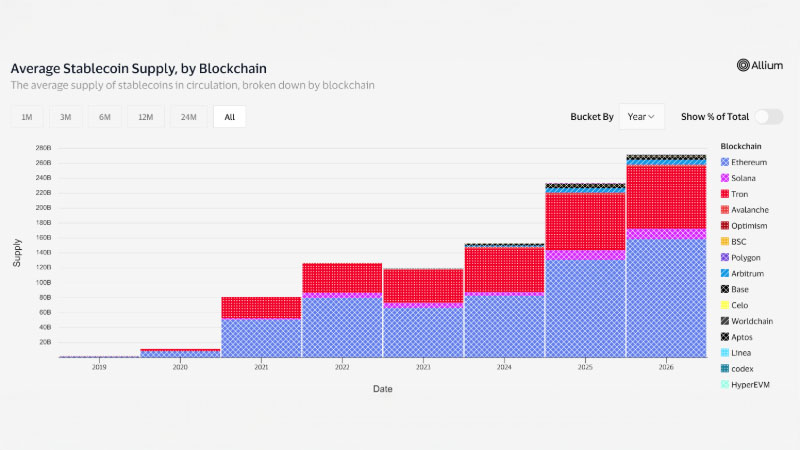
What matters is that these networks, along with the stablecoin issuers and DeFi protocols built on them, begin planning their quantum readiness strategies now. The timeline for cryptographic migration is measured in years, not months.
Timeline and preparedness
Estimates vary widely on when "cryptographically relevant" quantum computers will emerge. But the uncertainty works in the industry's favor. Post-quantum standards already exist (NIST), and blockchain networks have proven they can coordinate complex upgrades (Ethereum's proof-of-stake transition, Bitcoin's Taproot).
Financial institutions working with stablecoins should begin planning now to ensure adequate lead time. This includes evaluating post-quantum algorithms, upgrading key management infrastructure and participating in industry coordination efforts.
How institutions should prepare
1. Protocol-level preparation
Evaluate post-quantum schemes: ML-DSA (balanced performance), SLH-DSA (conservative/hash-based) and Falcon (compact signatures). Many chains will adopt hybrid classical/quantum approaches during transition.
2. Enhanced key management
Upgrade infrastructure today using account abstraction, MPC wallets, and threshold signatures – designed to migrate smoothly without disrupting customers.
3. Industry coordination
Join working groups establishing best practices, upgrade schedules, and testing frameworks through standards bodies and blockchain consortiums.
Which post-quantum signatures will win?
Different ecosystems will choose different solutions based on their specific requirements:
- ML-DSA: Best balance for high-throughput applications
- SLH-DSA: Conservative, hash-based security (larger signatures)
- Falcon: Efficient and compact (resource-constrained use cases)
Different blockchain ecosystems may choose different algorithms based on their specific requirements. What matters is beginning the evaluation and testing process now, ensuring that when protocols are ready to upgrade, institutions have the expertise and infrastructure in place.
The path forward for stablecoins and digital payments
Quantum computing is advancing from research laboratories toward practical applications. This evolution represents an opportunity for the entire financial sector to modernize its cryptographic infrastructure, not just blockchain systems.
Stablecoins are becoming a meaningful part of the global payments ecosystem. At Visa, we're seeing this firsthand through our work with stablecoin settlement, where qualified partners can now settle using USDC across multiple blockchains. We're also enabling stablecoin-linked Visa cards in more than 40 countries, connecting crypto-native platforms to a network of over 150 million merchant locations.
As the stablecoin ecosystem continues to scale, ensuring long-term security is a shared responsibility. The industry's ability to coordinate around quantum readiness will determine how smoothly this transition occurs. By investing in post-quantum research, upgrading key management infrastructure, and participating in standards development, financial institutions can ensure that stablecoins remain a reliable, secure foundation for digital commerce.
Taking action
Institutions exploring or currently working with stablecoins should start by assessing their current cryptographic infrastructure and developing a quantum readiness roadmap. This includes:
- Evaluate which systems use quantum-vulnerable algorithms
- Plan key management upgrades supporting algorithm flexibility
- Participate in industry working groups focused on post-quantum standards
- Test implementations in non-production environments
The crypto industry has repeatedly demonstrated its ability to tackle complex infrastructure challenges. Quantum readiness is the next item on that list, and with proper planning, it's an entirely manageable one.
Visa's role in quantum readiness
Visa is actively engaged in this work through our blockchain and stablecoin infrastructure initiatives.
Visa Consulting and Analytics (VCA) and the newly announced Global Stablecoin Advisory Practice helps banks, fintechs, and merchants navigate the evolving stablecoin landscape, including long-term infrastructure considerations.
Visa is committed to ensuring that as stablecoins scale, they do so on a foundation that's secure, reliable, and built for the future.